What Are Input Tax and Output Tax? 8 Prohibited Input Tax Items Business Owners Often Miss
Article Content
What Are Input Tax and Output Tax? 8 Prohibited Input Tax Items Business Owners Often Miss (Heavy Penalties for Mistakes!)
For business operators who already understand the differences between VAT 7%, 0%, and VAT exemption, the next important concept to learn is "input tax" and "output tax" - the core of monthly business operations. However, confusion often arises when deciding which "input tax" items can actually be deducted from "output tax." Even minor misunderstandings about prohibited input tax claims can lead to tax assessments with substantial penalties and surcharges.
This article from Orbit Advisory will help you understand the essence of input tax and output tax, how to correctly calculate the tax base according to law, and most importantly, reveal the list of "prohibited input tax" items commonly encountered to ensure your business complies with the law safely and correctly.
Value Added Tax: The Relationship Between "Input Tax" and "Output Tax"
Before diving into details, let's review the fundamental principles of Value Added Tax. VAT is a tax collected from the sale of goods or services, with a simple calculation formula for the tax that must be paid to the Revenue Department each month:
Tax Payable (or Refundable) = Output Tax - Creditable Input Tax
- Output Tax: This is the Value Added Tax (7%) that your business "collects" from customers when selling goods or providing services, as referenced in Section 77/1(4) of the Revenue Code
- Input Tax: This is the Value Added Tax (7%) that your business "is charged" when purchasing goods or using services from VAT-registered suppliers, as referenced in Section 77/1(5) of the Revenue Code
The challenge isn't in the calculation but in distinguishing which input tax items are "creditable" and which are "prohibited input tax"
Tax Base for "Output Tax" - How is it Calculated?
According to Section 79 of the Revenue Code, the tax base for selling goods or providing services is the total amount that the business operator receives or is entitled to receive from selling goods or providing services, which includes:
- Price of goods or services: The net value agreed upon in the transaction
- Excise tax: If the goods or services are also subject to excise tax, this must be included in the VAT base calculation
- Fees or other monies: With similar characteristics
Items NOT to be included in the output tax base:
- Discounts or reductions that the business operator grants at the time of selling goods or providing services and clearly shown on the tax invoice
The List of 8 Prohibited Input Tax Items (Non-Creditable Input Tax) You Must Know!
This is the most important section. According to Section 82/5 of the Revenue Code and Revenue Department Departmental Order Regarding Value Added Tax (No. 42), the types of input tax that are not permitted to be deducted from output tax are clearly defined as follows:
1. Input tax without tax invoices or with invoices that cannot be presented:
- Reason: No evidence to confirm the payment of that input tax
- Caution: Documents lost or no tax invoice received from the seller
2. Input tax from "incorrect" or "incomplete" tax invoices:
- Reason: Tax invoice contains incorrect information as required by law (e.g., incorrect name, address, taxpayer identification number)
- Caution: Must verify the correctness of tax invoices every time they are received
3. Input tax not directly related to business operations:
- Reason: These are personal expenses of directors or employees, not for the direct benefit of the company
- Example: Purchasing personal items and then using the tax invoice for company reimbursement
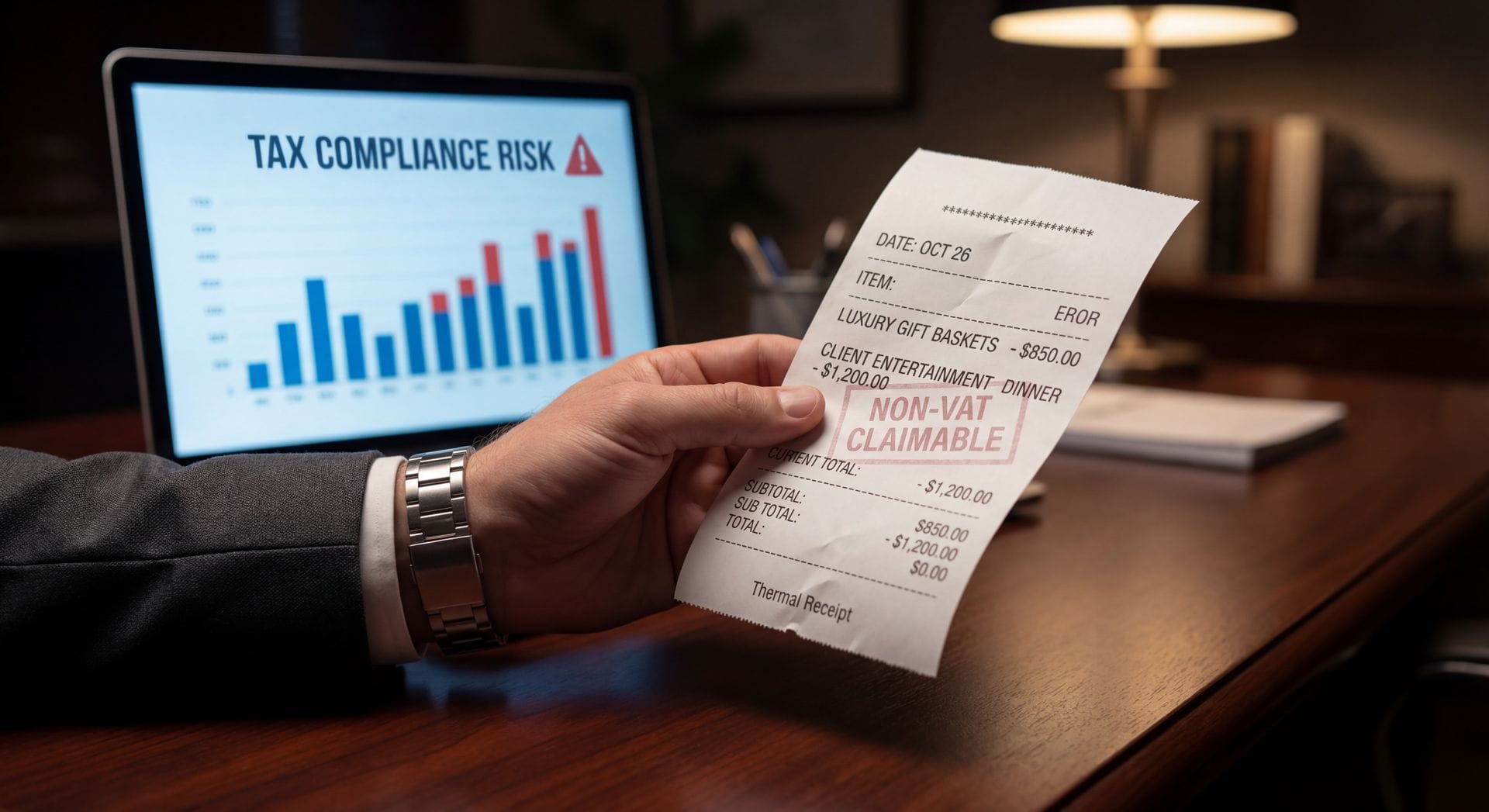
4. Input tax arising from "entertainment expenses" or expenses with similar characteristics:
- Reason: The law considers these as expenses for building business relationships, not direct costs
- Example: Food, beverage, and accommodation expenses used for entertaining customers (even though some portion may be deductible as corporate income tax expenses, input tax from these expenses cannot be claimed for refund)
5. Input tax arising from the purchase, hire-purchase, or transfer of "passenger cars and passenger vehicles with not more than 10 seats":
- ⚠️ This is the most commonly missed item! Input tax related to passenger cars (sedans) such as fuel costs, maintenance costs, spare parts, insurance premiums cannot be claimed for refund
- Exception: If it's a pickup truck (commercial vehicle) or a vehicle with more than 10 seats, related input tax can be claimed for refund if used in business operations
6. Input tax according to abbreviated tax invoices:
- Reason: Abbreviated tax invoices do not contain sufficient information to identify the buyer
- Exception: Retail businesses can record input tax from abbreviated tax invoices as expenses, but cannot claim input tax refunds
7. Input tax arising from construction of buildings or real estate for use in "VAT-exempt" business operations:
- Reason: When the final outcome (revenue) is VAT-exempt, related costs should not receive VAT refund rights
- Example: Real estate company builds apartments for rental (property rental is VAT-exempt), therefore all input tax from construction costs cannot be claimed for refund
8. Input tax as additionally specified by the Director-General of the Revenue Department:
- Example: Input tax arising from the purchase of assets for use or intended for use in VAT-exempt business operations
Comparison Table: Creditable vs. Prohibited Input Tax
| Expense Type | Creditable Input Tax ✅ | Prohibited Input Tax ❌ |
|---|---|---|
| Raw materials for production | ✅ (Directly related to business) | - |
| Office rental | ✅ (Has correct full tax invoice) | - |
| Office electricity/water | ✅ (Has correct full tax invoice) | - |
| Fuel for delivery pickup truck | ✅ (Commercial vehicle) | - |
| Fuel for executive sedan | - | ❌ (Passenger vehicle not exceeding 10 seats) |
| Sedan maintenance costs | - | ❌ (Passenger vehicle not exceeding 10 seats) |
| Customer entertainment meals | - | ❌ (Entertainment expenses) |
| Telephone/internet | ✅ (Used in business and has tax invoice) | - |
Case Study Example
Orbit Technology Co., Ltd. operates a computer equipment sales business. In December 2023, the company had the following transactions:
- Product sales (before VAT): 800,000 THB
- Output Tax: 800,000 x 7% = 56,000 THB
- Purchases and expenses:
- Purchase of goods for resale (with correct tax invoice): 500,000 THB (input tax 35,000 THB)
- Office rent (with correct tax invoice): 30,000 THB (input tax 2,100 THB)
- Fuel for delivery pickup truck: 10,000 THB (input tax 700 THB)
- Customer lunch entertainment: 5,000 THB (input tax 350 THB) 👈 Prohibited input tax
- Director's sedan maintenance: 8,000 THB (input tax 560 THB) 👈 Prohibited input tax
VAT Calculation to be Paid:
- Total input tax paid: 35,000 + 2,100 + 700 + 350 + 560 = 38,710 THB
- Separate prohibited input tax:
- Input tax from entertainment: 350 THB
- Input tax from sedan maintenance: 560 THB
- Total prohibited input tax: 350 + 560 = 910 THB
- Calculate creditable input tax: 38,710 - 910 = 37,800 THB
- Calculate VAT payable (Form VAT 30):
- Output Tax - Creditable Input Tax
- 56,000 - 37,800 = 18,200 THB
💡 Note: Although input tax from entertainment and sedan maintenance cannot be refunded, the expense amounts (5,000 and 8,000 THB) can still be recorded as expenses in year-end corporate income tax calculations under specified conditions.
⚠️ Warnings and Risks: What Happens if You Claim Prohibited Input Tax?
If the Revenue Department discovers that your business has used prohibited input tax for credit, it will be considered as underpaid tax, and you will be liable as follows:
- Pay the tax shortfall: Must pay value added tax equal to the amount of prohibited input tax used
- Penalty: May be charged a penalty at 1 to 2 times the amount of tax underpaid
- Surcharge: Must pay surcharge at 1.5% per month of the tax payable, calculated from the day after the filing deadline until the date of full payment
Even minor mistakes can cause unexpected financial damage to your business.
Summary and Best Practices
Managing input tax and output tax is an important responsibility for business operators. Understanding which input tax items can be claimed for refund and which are prohibited will help you file Form VAT 30 correctly, reducing the risk of inspection and back tax assessments.
The key is verifying every tax invoice for correctness and completeness, and categorizing expenses in strict compliance with legal requirements.
Managing Value Added Tax can be complex with numerous detailed requirements. If you are unsure or need to establish a robust accounting and tax system, consult with experts from Orbit Advisory to ensure your business grows steadily and without tax worries.
Frequently Asked Questions (FAQ)
Q1: Can input tax from abbreviated tax invoices be used?
A: It cannot be deducted from output tax (VAT refund not available), but the value of goods/services can be recorded as business expenses in corporate income tax calculations.
Q2: What should I do if I receive a tax invoice with incorrect information?
A: You must immediately notify the tax invoice issuer (seller) to cancel the original invoice and issue a new correct one immediately. You should not use an incorrect tax invoice for tax credit claims.
Q3: Customer entertainment expenses cannot get VAT refunds - can they be deducted as year-end expenses?
A: Yes, although input tax from entertainment expenses cannot be refunded, the value of those expenses can be deducted as expenses in calculating net profit for corporate income tax under conditions specified in the Revenue Code (e.g., must not exceed 0.3% of revenue or paid-up capital).
Q4: What is the validity period for claiming input tax credit?
A: Input tax arising in any particular month can be used for credit within 6 months following the month the tax invoice was issued.
Q5: Can a business that rents passenger cars claim input tax refunds from purchasing vehicles?
A: Yes, if your business is directly selling or renting passenger cars, the vehicles are considered "goods" of the business. Therefore, input tax from purchasing vehicles can be claimed for refund, which is an important exception.
📚 Related Articles

Which VAT Rate Applies to Your Business? Complete Guide Comparing VAT 7%, 0%, and 'Exempt Businesses'
Thailand has 3 VAT treatments: 7% standard, 0% for exports, and VAT-exempt for certain businesses. This guide helps you identify which applies to yours.
Input Tax Apportionment: What Is It? Which Businesses Must Do It? Heavy Penalties for Non-Compliance!
Mixed-business VAT registrants must apportion input tax between taxable and exempt activities. Missing this rule can trigger serious Revenue Department penalties.
Document Retention Requirements: Essential Guide to Accounting and Tax Compliance in Thailand
How long must Thai businesses keep accounting and tax documents? Minimum 5 years by law — this guide breaks down what to keep and why.
Swipe to see more →
Ready to Take Action?
Our expert team is ready to help you achieve your financial goals. Contact us through your preferred channel.