Which VAT Rate Applies to Your Business? Complete Guide Comparing VAT 7%, 0%, and 'Exempt Businesses'

Article Content
Which VAT Rate Applies to Your Business? Complete Guide Comparing VAT 7%, 0%, and 'Exempt Businesses' - Heavy Penalties for Mistakes!
"Should our products include 7% VAT?" "Why do we need to file VAT returns at 0% rate for exports?" "Do I need to register VAT for a small retail shop?"
These are common questions that many business owners, especially new entrepreneurs, are still confused about and cannot answer decisively. Value Added Tax (VAT), while seemingly straightforward, has complexities in details that directly impact business pricing, costs, and profits. Even small misunderstandings can lead to unnecessary fines and additional costs.
This article from Orbit Advisory serves as a complete guide to help you clearly understand the differences between the three types of businesses related to Value Added Tax: businesses subject to VAT 7%, businesses subject to VAT 0%, and VAT-exempt businesses. We have compiled important information, legal references, and easy-to-understand comparison tables to enable you to identify your business type and comply with legal requirements correctly.
What is Value Added Tax (VAT)?
Before diving into the details of each category, let's first understand the basic principles. Value Added Tax is a tax collected from the sale of goods or provision of services at each stage of production and distribution within the Kingdom, including the importation of goods, as stipulated in the Revenue Code.
Generally, businesses with annual revenue exceeding 1.8 million baht are required to register as Value Added Tax operators and collect VAT from customers at the rate prescribed by law (currently 7%) for remittance to the Revenue Department. However, the law has specified exemptions and special rates for certain businesses, which can be divided into three main categories as follows:
Comparison Table: VAT 7% vs VAT 0% vs VAT-Exempt Businesses
To get the clearest overview, let's look at this comparison table:
| Comparison Topic | Businesses Subject to VAT 7% | Businesses Subject to VAT 0% | VAT-Exempt Businesses |
|---|---|---|---|
| Tax Rate Collected | 7% | 0% | No VAT collection required |
| Legal Status | Registered VAT operator | Registered VAT operator | Not a registered VAT operator (except small businesses) |
| PP.30 Filing Obligation | ✅ Must file monthly (even if no transactions) | ✅ Must file monthly | ❌ No filing required |
| Input Tax Refund Rights | ✅ Has rights to offset input tax against output tax | ✅ Has rights to claim full input tax refund | ❌ No rights to use or claim input tax refunds (treated as cost) |
| Business Examples | • General consumer goods retail • Restaurants • Construction contractors • Consulting services • Hotels | • Export of goods • Services used abroad • International transportation by ship or aircraft | • Unprocessed agricultural products • Property rental • Hospitals, educational institutions • Domestic transportation services |
---
Deep Dive into Business Types and Value Added Tax Obligations
To help you understand thoroughly, let's examine the details of each category:
1. Businesses Subject to 7% Value Added Tax
This is the majority group of businesses in the economic system. According to Section 80 of the Revenue Code, general sales of goods, provision of services, or imports within the Kingdom are subject to Value Added Tax at 10%, but currently a Royal Decree has reduced the rate to 7%.
💡 Key Principles:
- Registered Operator: When revenue exceeds 1.8 million baht/year, must register for VAT
- Tax Invoice Obligation: Must issue full or abbreviated tax invoices to customers
- PP.30 Filing Obligation: Must file Value Added Tax returns (Form PP.30) monthly by the 15th day of the following month
- Input Tax Rights: Can offset input tax (VAT paid on raw materials or services) against output tax (VAT collected from customers)
Business Examples:
- Retail and wholesale general goods stores
- Various service businesses such as restaurants, hotels, consultants, construction contractors
- Industrial factories producing goods for domestic sale
- Importers bringing goods from abroad for domestic sale
2. Businesses Subject to 0% Value Added Tax
Many people may wonder how "paying 0% tax" differs from "tax exemption." The difference is very significant. This group of businesses remains as registered VAT operators and has all the same obligations as the 7% group, but only collects tax at the 0% rate.
According to Section 80/1 of the Revenue Code, businesses subject to 0% VAT are specified, with the main objective of supporting exports and avoiding double taxation in international trade.
💡 Key Principles:
- Registered VAT Operator: Has same status and obligations as the 7% group
- Collects 0% VAT: When selling goods or providing services, specifies 0% tax rate on tax invoices
- Still Must File PP.30: Must file returns monthly as usual
- ✅ Maximum Benefits: Can claim refunds of all input tax incurred from business operations, making exported goods or services free from hidden Value Added Tax costs
Business Examples:
- Export of goods: Clothing manufacturing company exports to sell in Japan
- Services performed in the Kingdom but used abroad: Thai company hired to write programs for clients in Singapore
- International transportation by aircraft or sea-going vessels: Airlines providing passenger transportation from Bangkok to London
- Sale of goods or services to United Nations organizations or various embassies
3. VAT-Exempt Businesses
This group of businesses is legally specified as not having to pay Value Added Tax at all, not required to register for VAT, and has no obligation to file PP.30 returns.
According to Section 81 of the Revenue Code, VAT-exempt businesses are clearly listed. Most are basic goods or services essential for livelihood, or are public services.
💡 Key Principles:
- No VAT Registration Required: Even if revenue exceeds 1.8 million baht/year, no registration required (except small businesses with exemption rights)
- Prohibited from Collecting VAT: Cannot issue tax invoices and collect VAT from customers
- No PP.30 Filing Required: No obligations related to Value Added Tax filing
- ⚠️ Limitations: Cannot claim refunds or use input tax from business costs as credits. Such input tax is immediately counted as part of the cost of those goods or services
Business Examples:
- Unprocessed Agricultural Products: Sale of fresh vegetables, fresh pork, rice grains (but if processed into canned food, not exempt)
- Certain Essential Goods: Fertilizers, animal feed, textbooks, newspapers
- Public Services: Domestic transportation services (e.g., buses, electric trains), medical services from hospitals, educational services from schools
- Professional Services: Medical practice, legal representation, accounting services
- Property Rental Services
⚠️ Important Considerations and Penalties for Non-Compliance
Incorrectly identifying your business type can lead to severe penalties from the Revenue Department:
- Case of Required VAT Registration but Not Registered:
- Criminal Penalty: Imprisonment not exceeding 1 month, or fine not exceeding 5,000 baht, or both
- Surcharge: Twice the amount of tax payable during the period of non-registration, or 1,000 baht per month, whichever is greater
- Case of Late or Incorrect PP.30 Filing:
- Criminal Fine: Failure to file within deadline, fine not exceeding 2,000 baht
- Surcharge: 1-2 times the amount of tax underpaid
- Additional Amount: Calculated at 1.5% per month of the tax payable, with fractional months counted as full months
Summary
Understanding whether your business falls into the category of paying VAT 7%, VAT 0%, or being VAT-exempt is the crucial first step in tax planning and running your business legally. The important key to remember is that 0% rate businesses remain within the VAT system and have rights to full input tax refunds, which provides significant benefits, while VAT-exempt businesses are completely outside the VAT system and cannot use any input tax rights whatsoever.
Properly establishing accounting and documentation systems from the beginning can greatly reduce risks and errors. If you're still not sure which category your business belongs to, or need in-depth consultation to plan taxes for maximum benefit, the expert team from Orbit Advisory is ready to provide consultation.
Frequently Asked Questions (FAQ)
Q1: What's the difference between 0% VAT businesses and VAT-exempt businesses?
A: The difference lies in "input tax refund rights." 0% VAT businesses remain within the VAT system and thus have rights to full input tax refunds, meaning no hidden tax costs. However, VAT-exempt businesses are outside the VAT system and cannot claim input tax refunds, so input tax becomes part of the business cost.
Q2: What should I do if my revenue hasn't reached 1.8 million baht per year?
A: You will be automatically exempt from Value Added Tax registration as a "small business," but you have the right to apply for VAT registration to enter the system if you want to use input tax benefits.
Q3: Do apartment rental businesses need to register for VAT?
A: No, property rental services are exempt from Value Added Tax under Section 81(1)(ต) of the Revenue Code.
Q4: If a company does both export business (0% VAT) and domestic sales (7% VAT), what should they do?
A: Your company must register for VAT and file a single PP.30 return, but the return must show sales figures separated between 7% rate sales and 0% rate sales. Input tax incurred must be averaged according to income portions (Average Tax), which is complex and should be consulted with experts.
Q5: What should I do if I forget to file PP.30?
A: File the return as soon as possible at the nearest Revenue Department branch office. You must pay tax (if any) along with criminal fines for late filing and additional amounts at 1.5% per month of the tax payable.
📚 Related Articles
Input Tax Apportionment: What Is It? Which Businesses Must Do It? Heavy Penalties for Non-Compliance!
Mixed-business VAT registrants must apportion input tax between taxable and exempt activities. Missing this rule can trigger serious Revenue Department penalties.
Document Retention Requirements: Essential Guide to Accounting and Tax Compliance in Thailand
How long must Thai businesses keep accounting and tax documents? Minimum 5 years by law — this guide breaks down what to keep and why.
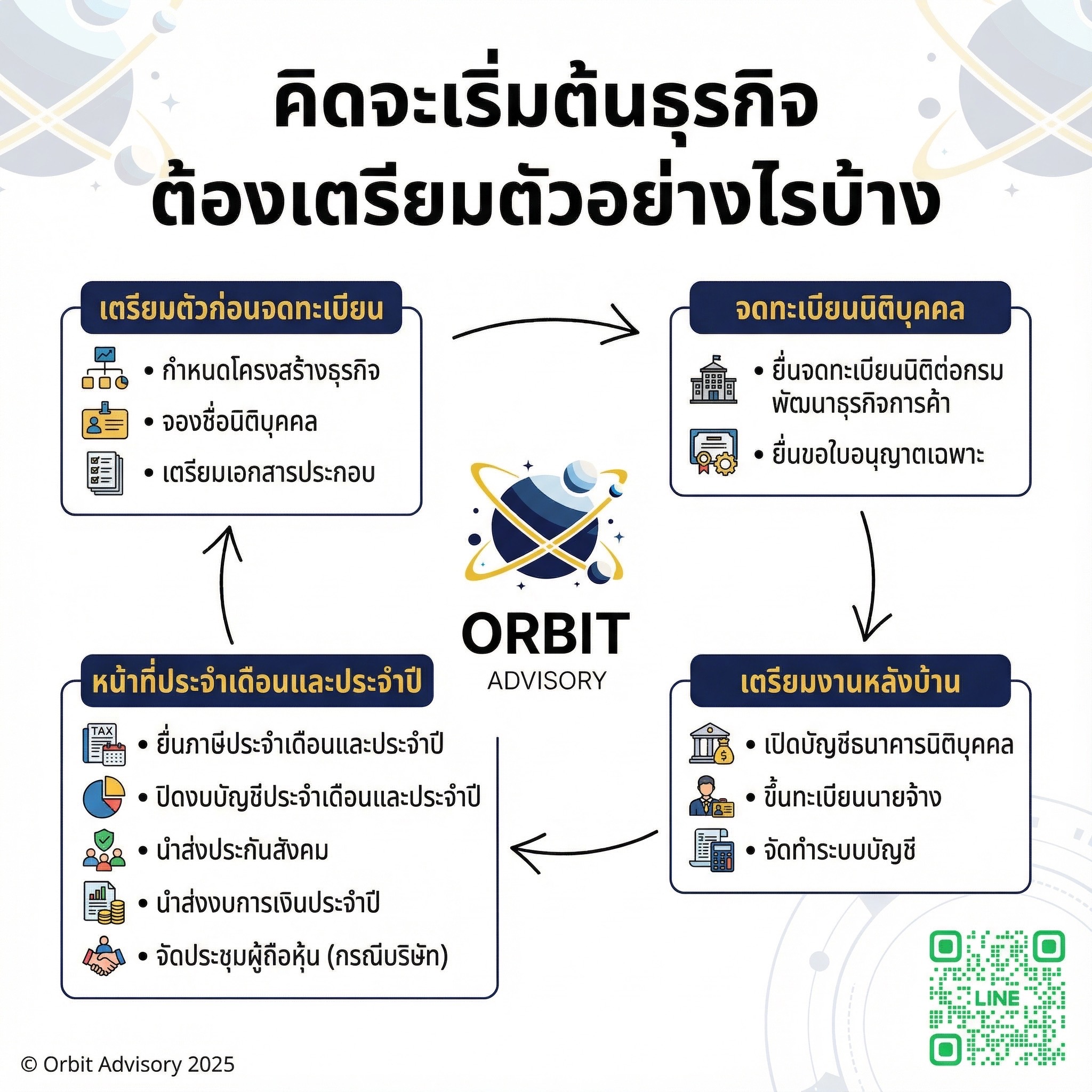
Complete Guide to Company Registration in Thailand: Steps, Documents, and Fees
Step-by-step guide to registering a company in Thailand: required documents, DBD process, fees, and first-year tax obligations.
Swipe to see more →
Ready to Take Action?
Our expert team is ready to help you achieve your financial goals. Contact us through your preferred channel.