Platforms Are Sending Your Revenue Data to Thailand's Revenue Department — What Online Sellers Must Do Now
Article Content
Platforms Are Sending Your Revenue Data to Thailand's Revenue Department — What Online Sellers Must Do Now
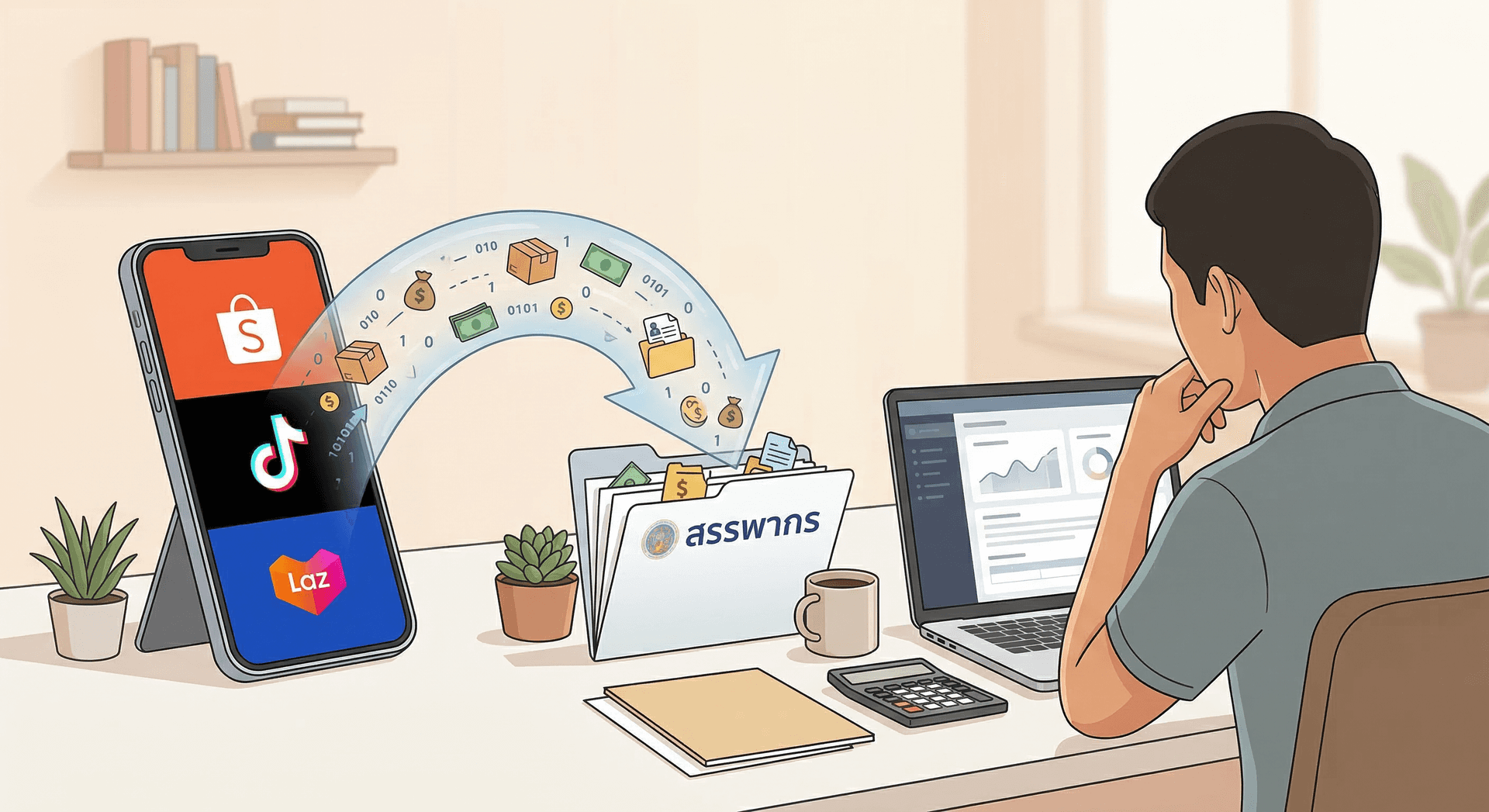
Since 2024, platforms like Shopee, Lazada, and TikTok Shop are legally required to report every store's revenue data to the Revenue Department annually. Data for 2024 was already submitted to the Revenue Department in May 2025. Stores that have not yet filed taxes — or have filed incorrectly — must immediately review their historical revenue and consult a specialist before the Revenue Department begins cross-checking the data.
You've been selling on Shopee, Lazada, or TikTok Shop for a while, but you're not sure whether you need to file taxes — or how? You're not alone. Many online sellers still don't know that since 2024, these platforms are legally required to submit your store's revenue data directly to the Revenue Department.
This article explains everything: what this law is, what data is reported, and what online stores must do right now to avoid future problems with the Revenue Department.
What Is This Law? Why Must Platforms Report Revenue to the Revenue Department?
The Revenue Department issued the Director-General's Announcement on Requiring Electronic Platforms to Maintain Special Accounts on December 27, 2023, under authority granted by Section 17 (มาตรา 17) of the Revenue Code — which empowers the Director-General to require any person to maintain special accounts for tax collection purposes.
The objective of this law is clear: to bring online business operators who are not yet in the tax system into proper income reporting compliance. The Revenue Department estimates that significant e-commerce revenue remains undeclared in tax filings.
What is called the Special Account (บัญชีพิเศษ) is a revenue data report on every seller operating through that platform — which the platform must compile and submit to the Revenue Department through the department's electronic system.
Which Platforms Are Required to Report Seller Revenue?
Not every platform is required to report. The law specifies the following conditions:
| Condition | Details |
|---|---|
| Registered in Thailand | Must be a legal entity incorporated and registered in Thailand |
| Revenue exceeds threshold | Annual revenue in the accounting period must exceed 1,000 million baht (1 billion baht) |
| Not exempted | Must not be a platform under the supervision of the Bank of Thailand (BOT) or the Securities and Exchange Commission (SEC) |
Platforms directly affected that meet the revenue threshold include Shopee, Lazada, TikTok Shop, Line Man, and Grab. All are registered in Thailand and have annual revenues exceeding 1 billion baht.
💡 For stores selling directly on Facebook or Instagram: this law does not directly apply to those platforms yet. However, the Revenue Department has other channels (the e-Payment tax system) to track that data anyway.
What Data Does the Revenue Department Receive from Platforms?
The data platforms must report on each store is very detailed — not just a total revenue figure. According to reports, the Special Account data includes at minimum:
- National ID number or company registration number (depending on whether the store is registered as an individual or a company)
- Seller name and store name
- Total annual revenue received through that platform
- Commissions and fees charged by the platform
- Bank account used to receive transfers from the platform
In short: the Revenue Department knows your store name, your ID number, how much you sold, and which bank account the money went into.
When Was the Data Sent to the Revenue Department — and Does It Already Have Your Store's Data?
The Revenue Department received revenue data for 2024 from platforms as of May 2025. This is because the law requires submission within 150 days after the end of the accounting year. The table below shows a clear timeline of when your store's revenue data reached the Revenue Department.
| Data Period | Time Range | Submission Deadline | Status (as of Mar 2026) |
|---|---|---|---|
| Year 2024 | Jan 1, 2024 – Dec 31, 2024 | By May 29, 2025 | ✅ Submitted — Revenue Department has the data |
| Year 2025 | Jan 1, 2025 – Dec 31, 2025 | By May 29, 2026 | ⏳ Being compiled — submission due late May |
⚠️ Revenue data for 2024 has been in the Revenue Department's hands since May 2025. This means stores that filed their 2024 annual tax return (ภ.ง.ด.90 filed in March 2025) incorrectly may already be subject to data cross-checking.
📌 If you filed your 2024 ภ.ง.ด.90 but the figures don't match your actual sales: the Revenue Department can directly compare your filed data against platform-submitted data. If discrepancies are found, an audit summons may follow. The sooner you correct this, the greater the penalty reduction you can obtain.
What Taxes Do Online Stores Need to File?
Online sellers' tax obligations fall into three main categories:
1. ภ.ง.ด.94 — Mid-Year Tax Return
Revenue from online selling is classified as income under Section 40(8) (มาตรา 40(8)) of the Revenue Code — a category that also requires a mid-year tax filing.
If income from January through June of that year exceeds 60,000 baht (for single filers) or 120,000 baht (for married filers), you must file ภ.ง.ด.94 by September 30 of that year, under Section 56 Bis (มาตรา 56 ทวิ) of the Revenue Code.
For more on calculating taxes on online selling income, including the 60% flat expense deduction, see our article on Online Seller and Influencer Income Tax — Section 40(2) vs 40(8) Deep Dive.
2. ภ.ง.ด.90 — Annual Tax Return
At the end of the tax year, you must file a personal income tax return using ภ.ง.ด.90 by March 31 of the following year (or approximately April 8–10 if filing online).
The minimum threshold requiring a filing is total annual income exceeding 60,000 baht for single filers, or 120,000 baht for married filers. For more on the 8 income types and expense deduction rights, see our article on 8 Types of Personal Income Tax Under Section 40 — How to Deduct Expenses.
3. VAT — Value Added Tax
If total annual revenue exceeds 1,800,000 baht, you must register for VAT within 30 days of the date revenue crosses that threshold, and must file ภ.พ.30 every month thereafter.
Stores that have not yet reached the 1.8 million baht threshold are exempt from VAT registration — but must still file income taxes under items 1 and 2 above.
Besides Platforms, Does the Revenue Department Receive Online Seller Data from Other Sources?
Beyond the Special Account data from platforms, the Revenue Department receives data from another channel that online sellers should know about.
The e-Payment Tax Law requires all financial institutions — including banks, PromptPay, and electronic wallets — to report account data meeting either of these criteria:
- Receiving transfers/deposits 3,000 times or more per year (regardless of amount)
- Or receiving transfers/deposits 400 times or more AND with a total exceeding 2,000,000 baht per year
Online sellers who receive transfers to their bank accounts daily are very likely to meet these thresholds — because platforms transfer funds daily or weekly, which easily accumulates to hundreds or thousands of transactions per year.
The result is that the Revenue Department has data from 2 sources simultaneously: directly from platforms and from banks, making cross-referencing far easier.
💡 Sellers on multiple platforms: If you sell on Shopee, Lazada, and TikTok Shop simultaneously, the Revenue Department receives revenue data from each platform separately and combines all channel totals in its tax assessment. Spreading sales across multiple platforms does not reduce the revenue figure the Revenue Department can see.
What Happens If You've Been Selling Online for Years but Have Never Filed Taxes?
Consider Beam, who has been selling clothing on TikTok Shop since 2023 without ever filing taxes. In 2024, Beam earned a total of 1,200,000 baht in revenue from TikTok Shop.
TikTok has already submitted Beam's revenue data to the Revenue Department in May 2025.
Tax Beam should have paid for 2024:
| Item | Amount |
|---|---|
| Total revenue for 2024 | 1,200,000 baht |
| Less 60% flat expense deduction | (720,000 baht) |
| Income after expense deduction | 480,000 baht |
| Less personal allowance | (60,000 baht) |
| Net taxable income | 420,000 baht |
| Approximate tax liability | ~19,500 baht |
If Beam did not file ภ.ง.ด.90 in March 2025 and the Revenue Department discovers this from platform-submitted data, the amount owed won't just be 19,500 baht — it will include:
- 1.5% monthly surcharge on unpaid tax under Section 27 (มาตรา 27) of the Revenue Code
- Penalty of 1–2 times the tax owed under Sections 22 and 26 (มาตรา 22 และ 26) of the Revenue Code
However, if Beam decides to file voluntarily before the Revenue Department issues a summons, Beam has the right to request a reduction or waiver of the penalty. This is why acting as quickly as possible is so important.
If you are in a situation similar to Beam's, Orbit Advisory is ready to help calculate back taxes, prepare documentation, and plan a proper filing.
What Are the Penalties for Not Filing or Filing Incorrectly?
The law separates liability into two levels:
Level 1 — Administrative Penalties (General Cases):
| Penalty | Rate | Note |
|---|---|---|
| Surcharge | 1.5%/month of unpaid tax | Section 27 of the Revenue Code |
| Penalty (assessed case) | 1–2 times the tax shortfall | Sections 22, 26 of the Revenue Code |
| Late filing fine | Not exceeding 2,000 baht for failure to file | — |
Level 2 — Criminal Penalties (Intentional Cases):
If the Revenue Department can prove intent to file false information or commit fraud to evade taxes, the penalties under Section 37 (มาตรา 37) of the Revenue Code are imprisonment of 3 months to 7 years, plus a fine of 2,000 to 200,000 baht.
⚠️ Stores that have never filed taxes at all and have income exceeding the threshold carry higher risk than stores that filed incorrectly — because never filing at all shows a more obvious pattern.
Pre-2024 income also carries risk: Although the Special Account law took effect from 2024, the Revenue Department has the authority to audit taxes retroactively for up to 5 years. Stores that started selling online from 2021–2023 and have never filed taxes are still at risk of the Revenue Department using 2024 data as a starting point to trace back to prior years.
What Should Online Stores Do Right Now?
- Review your historical revenue — Check your total revenue from each platform's dashboard starting from 2024 back to the year you started selling. You can find the figures at:
- Shopee: Seller Centre → Finance → My Income → Select the period you need
- Lazada: Seller Center → Finance → Payment → View Monthly Statement
- TikTok Shop: Seller Center → Finance → Revenue Overview
- Check whether you have filed ภ.ง.ด.90 and ภ.ง.ด.94 for all required years — If income exceeded the threshold in any year and you haven't filed, plan to file retroactively.
- Keep all expense documentation — Cost of goods, packaging, shipping, advertising — to support your filing and reduce your tax base.
- Check whether revenue has reached 1.8 million baht — If it has, you must register for VAT immediately.
- Consult a specialist before filing back taxes — Filing retroactively is possible and reduces the risk of penalties far more than waiting for the Revenue Department to call. Having a specialist calculate and prepare documents correctly reduces the chance of repeating errors.
For information on withholding tax that platforms deduct from your store's fees — a common source of confusion about what action online sellers need to take — see our article on Withholding Tax on TikTok Shop and Shopee: What to Do Next and Can You Get a Refund?.
Summary: What Should You Do Right Now?
| Your Store's Situation | What You Must Do |
|---|---|
| Income below 60,000 baht/year | Not yet required to file — but keep records |
| Income 60,000 – 1,800,000 baht/year | File ภ.ง.ด.90 and ภ.ง.ด.94 on schedule |
| Income exceeds 1,800,000 baht/year | File income tax + register for VAT immediately |
| Selling for years but never filed | Consult a specialist for back-filing before being summoned |
The simplest step right now is to check your historical revenue from each platform's dashboard. Then bring those figures to a specialist to plan what needs to be filed and what expenses can be deducted.
⚡ Time matters: Revenue data for 2025 will be sent to the Revenue Department by late May 2026 — the sooner you get your taxes in order before that date, the more you reduce the risk of penalties and an audit summons.
If you need help filing taxes for your online store or planning ahead, Orbit Advisory is ready to advise. Contact us for a quote or learn more about our tax services first.
Frequently Asked Questions (FAQ)
Q1: Can I file back taxes if I've never filed before? A: Yes, you can file back taxes by submitting an amended ภ.ง.ด.90 at your local Revenue Department office or online via the RD e-Filing system. If you file before the Revenue Department issues a summons, you may request a reduction or waiver of penalties at the officer's discretion. However, you must still pay the tax owed plus a 1.5% monthly surcharge from the original due date under Section 27 (มาตรา 27) of the Revenue Code.
Q2: What is the "Special Account" (บัญชีพิเศษ) that platforms send to the Revenue Department? A: The Special Account (บัญชีพิเศษ) is an annual report that platforms like Shopee, Lazada, and TikTok Shop must prepare and submit to the Revenue Department under the Director-General's Announcement issued under Section 17 (มาตรา 17) of the Revenue Code. According to reports, the data includes each seller's national ID number, store name, total annual revenue, platform fees charged, and the bank account used to receive payments.
Q3: Does this affect small Shopee stores with low income? A: Yes. This law places the reporting obligation on the platform, not just high-revenue stores — every seller on the platform has their data reported. However, this doesn't mean every store owes tax. Sellers with total annual income under 60,000 baht (single filer) remain exempt. But the Revenue Department now has your data on file.
Q4: How much online selling income requires filing ภ.ง.ด.90? A: If your total income from all sources exceeds 60,000 baht per year (single filer) or 120,000 baht (married filer), you must file ภ.ง.ด.90 by March 31 of the following year. Online selling income is classified as Section 40(8) (มาตรา 40(8)) income under the Revenue Code, which qualifies for a flat 60% expense deduction.
Q5: What happens if the Revenue Department finds my filed income doesn't match platform data? A: The Revenue Department will issue an audit notice or additional tax assessment. Penalties include a 1.5% monthly surcharge on unpaid tax (Section 27 / มาตรา 27) and a penalty of 1–2 times the shortfall (Sections 22 and 26 / มาตรา 22, 26 of the Revenue Code). If intentional tax evasion is proven, criminal penalties under Section 37 (มาตรา 37) may apply — up to 7 years imprisonment. Filing correctly before being summoned is always the better option.
📚 Related Articles

Bookkeeping for Online Stores (Shopee / Lazada / TikTok Shop): What Must You Record? The Real Guide for Online Sellers
Online sellers on Shopee, Lazada & TikTok Shop must keep 6 types of accounting records by Thai law. Learn what documents, VAT reports, and penalties apply.
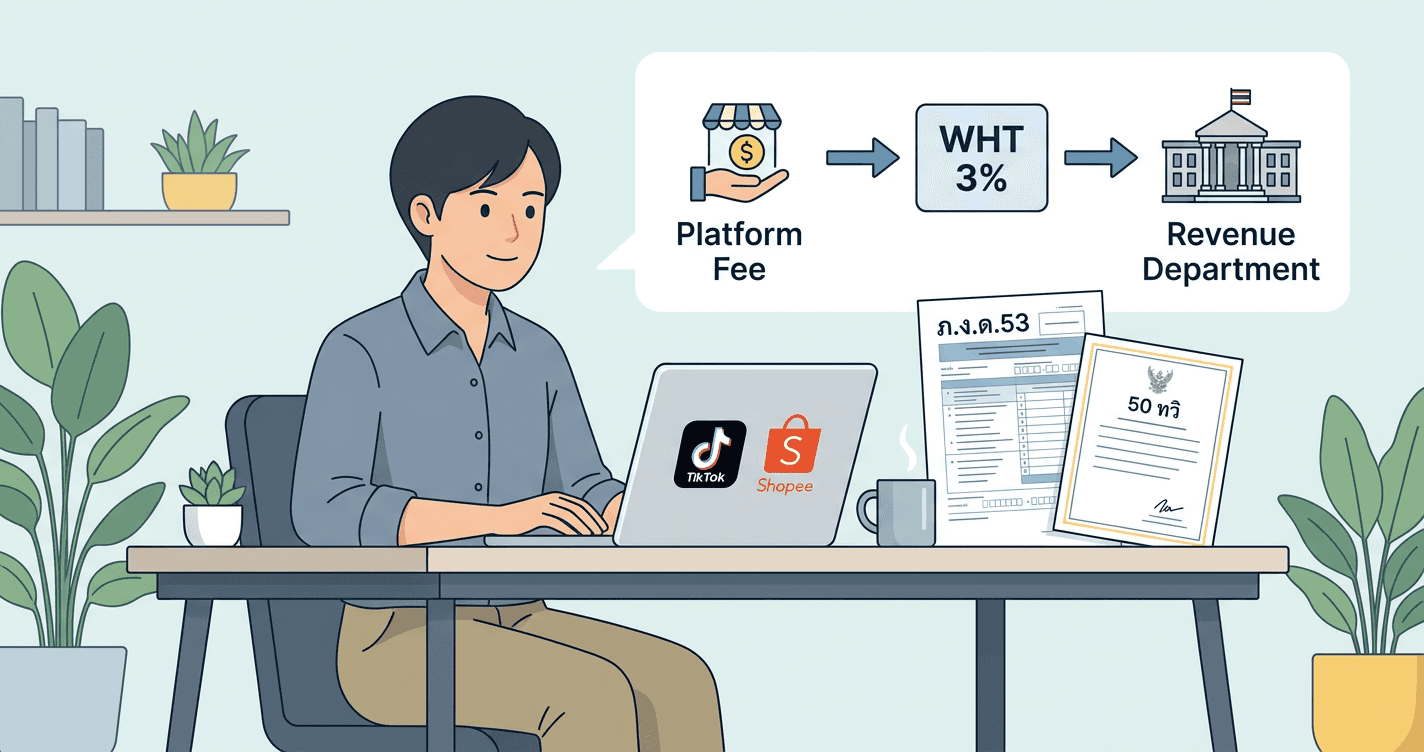
Withholding Tax on TikTok Shop and Shopee: Who Must Withhold, What Rate, and Can You Get a Refund?
Corporate sellers on TikTok Shop and Shopee must withhold tax at 3% on platform fees and 1% on logistics. Both platforms offer an agent system to handle monthly WHT filing automatically.

Online Sellers & Influencers: Which Tax Filing Method? Deep Dive into Income Types 40(2) vs 40(8) and Optimal Expense Deduction Strategies
Online sellers and influencers: is your income Section 40(2) or 40(8)? The answer determines your deduction rate and how much tax you legally pay.
Swipe to see more →
Ready to Take Action?
Our expert team is ready to help you achieve your financial goals. Contact us through your preferred channel.