Online Sellers & Freelancers: Should You Register a Company? Clear Comparison of Taxes, Credibility, and Growth

Article Content
Online Sellers & Freelancers: Should You Register a Company? Clear Comparison of Taxes, Credibility, and Growth
Are you a freelancer whose income is growing, or an online store owner whose sales are consistently hitting targets? A question that often arises for entrepreneurs at this stage is: "Is it time to register a company yet?" Some may worry about the complexity and costs of setting up, while simultaneously feeling frustrated about paying increasingly higher tax rates.
In this article, Orbit Advisory will guide you through a direct comparison between operating as a "Sole Proprietor" (Individual) versus a "Limited Company", focusing on three critical dimensions: tax burden, credibility, and growth opportunities, so you can clearly see which structure suits your business best in the long run.
Point 1: Tax Burden and Costs—Which Offers Better Value?
Tax is the most critical factor in decision-making. Let's examine the differences in depth.
Tax Structure and Cost Comparison
For maximum clarity, I've summarized the comparison in this table:
| Comparison Point | Sole Proprietor (Individual) | Limited Company (SME Eligible) |
|---|---|---|
| Income Type | Assessable Income under Section 40(2) (freelancers) or 40(8) (online sellers) | Business Income |
| Tax Rate | Progressive rates 0% - 35% based on net income brackets | Exempt (net profit 0-300,000 baht) 15% (net profit 300,001 - 3,000,000 baht) 20% (net profit exceeding 3,000,000 baht) |
| Expense Deduction | Two options: • Flat deduction: 60% for online sales (no ceiling) or 50% for some freelancer types (max 100,000 baht) • Actual deduction: Must have complete supporting documentation | Actual expenses only (As incurred) Must be business-related expenses with complete documentation per Revenue Code Sections 65/2 and 65/3 |
| Allowances | Available Personal, family, insurance, investment allowances | No personal allowances, but can deduct director expenses (e.g., salary) as company expenses |
| Complexity | • File tax (PND 90/91) once yearly • Simple income-expense bookkeeping | • Must have accountant and auditor • File tax (PND 50, 51) twice yearly • File social security, withholding tax (if applicable) |
💡 Key Decision Points:
- If your actual expenses exceed 60% of income: Registering a company to deduct all actual expenses may save you significantly more tax
- If your net profit is growing: When your net income exceeds 750,000 baht per year, individual tax rates enter the 20% bracket—the highest SME rate. Converting to a company may be an attractive option
Case Study: Freelance Graphic Designer
Mr. Bee is a freelance graphic designer with annual income of 2,000,000 baht and verifiable actual expenses (software, co-working space, client meeting travel) totaling 800,000 baht
Scenario 1: File as Individual (Income Type 40(2))
- Income: 2,000,000 baht
- Deduct expenses (choose flat 50% but max 100,000 baht): (100,000) baht
- Deduct personal allowances: (60,000) baht
- Net Income: 2,000,000 - 100,000 - 60,000 = 1,840,000 baht
- Calculate progressive tax:
- (150,000 x 0%) + (150,000 x 5%) + (200,000 x 10%) + (250,000 x 15%) + (250,000 x 20%) + (840,000 x 25%) = 0 + 7,500 + 20,000 + 37,500 + 50,000 + 210,000
- Tax payable: 325,000 baht
Scenario 2: Register Company with Same Income-Expenses
- Income: 2,000,000 baht
- Deduct actual expenses (including director salary to self 480,000 baht/year and other expenses 320,000 baht): (800,000) baht
- Company Net Profit: 2,000,000 - 800,000 = 1,200,000 baht
- Calculate Corporate Tax (SME rates):
- First 300,000 baht profit: Exempt (0 baht)
- Excess over 300,000 (900,000 baht): 900,000 x 15% = 135,000 baht
- Corporate Tax payable: 135,000 baht
✅ Result: In this case, operating as a company clearly results in lower tax liability. However, don't forget companies have hidden costs like monthly accounting fees and annual audit fees, which must be factored in.
Point 2: Credibility and Business Image
Image directly impacts business opportunities, especially when seeking expansion.
- Dealing with Large Partners: Most large organizations have policies to transact only with juristic persons for tax document clarity (tax invoices, withholding tax). Registering a company opens doors to larger business opportunities.
- Access to Funding: Financial institutions and banks more readily lend to "companies" than "individuals" because companies have audited financial statements and higher credibility, enabling clear assessment of business financial health.
- Customer Confidence: "Limited Company" status creates stability and professionalism for customers, especially in trust-intensive businesses.
Point 3: Shareholder Structure and Growth
If you envision future shareholders or fundraising, the company structure offers far more flexibility.
- Clear Asset Separation: A company is a separate juristic person from its owner (Limited Liability), meaning if the business has debts, creditors can only claim company assets, not the owner's personal assets (shareholders liable only for unpaid share value). Unlike individuals with unlimited liability across all personal assets.
- Fundraising and Adding Partners: Company structure is designed for ownership division through "shares", enabling systematic addition of partners or share sales for fundraising with clear legal support.
- Business Continuity: Companies can continue operating despite shareholder or director changes, ensuring greater business sustainability.
Warnings and Risks to Consider
⚠️ Sole Proprietor Risks:
- High Tax When Income Grows: When net income exceeds 1 million baht, you enter the 25% tax bracket, which continues rising—potentially a long-term burden.
- Unlimited Debt Liability: Personal assets aren't separated from business assets
⚠️ Limited Company Challenges:
- Complexity and Costs: Setup costs, monthly accounting fees, annual audit fees, and strict regulatory compliance
- Penalties for Non-Compliance: Late or incorrect tax filing may incur surcharges (up to 2x tax) and additions (1.5% monthly per Revenue Code Section 89)
Summary: Which Structure Suits Your Business?
To simplify decision-making, try answering these questions:
| If you're like this... | Recommended Structure |
|---|---|
| • Just starting, income uncertain • Actual expenses less than 60% of income • Don't need loans or partners yet • Want maximum flexibility | Sole Proprietor (Individual) |
| • Consistent growing income/profit (e.g., net profit exceeding 700,000 - 1,000,000 baht/year) • High business expenses with clear documentation • Want credibility for large partners/loans • Plan to seek future investors | Limited Company |
Transitioning from individual to company represents a significant business growth milestone requiring comprehensive consideration of tax, legal, and future objectives. Orbit Advisory has additional content to help you better understand company setup procedures and requirements in Complete Guide to Company Registration in Thailand: Steps, Documents, and Fees
If you're still uncertain which structure offers the best value for your business, consult Orbit Advisory experts for direct business structure analysis and customized tax planning
---
Frequently Asked Questions (FAQ)
Q1: If I register a company, must I register for Value Added Tax (VAT) immediately? A: Not necessarily. You're required to register for VAT only when your business income from VAT-taxable goods/services exceeds 1.8 million baht annually. If not yet exceeded, VAT registration isn't required.
Q2: What are the costs of setting up and maintaining a company? A: Generally includes: 1) Commercial Registration Department company registration fees 2) Monthly accounting service fees 3) Annual audit and financial statement closing fees. Costs vary by business size and complexity.
Q3: Can I be the sole owner of a company? A: Yes. Under current law, a limited company can have a single shareholder, enabling business owners to maintain 100% control.
Q4: Is director salary paid to myself fully deductible as company expense? A: Can be deducted as company expense, but must be set at reasonable market rates for the role and workload. This salary becomes personal income of the director, which must be calculated for personal income tax separately.
Q5: At what income level should I consider registering a company? A: No fixed number, but serious consideration should begin when "net profit" (income minus expenses) consistently exceeds 750,000 baht annually, as this is where individual tax rates (20%) exceed SME corporate tax rates in the second bracket (15%).
📚 Related Articles

Online Sellers & Influencers: Which Tax Filing Method? Deep Dive into Income Types 40(2) vs 40(8) and Optimal Expense Deduction Strategies
Online sellers and influencers: is your income Section 40(2) or 40(8)? The answer determines your deduction rate and how much tax you legally pay.

How Can Business Owners Withdraw Money from Their Company? 5 Legal and Tax-Efficient Methods Revealed
5 legal ways for Thai business owners to withdraw money from their company — with tax rates and compliance requirements for each method explained.
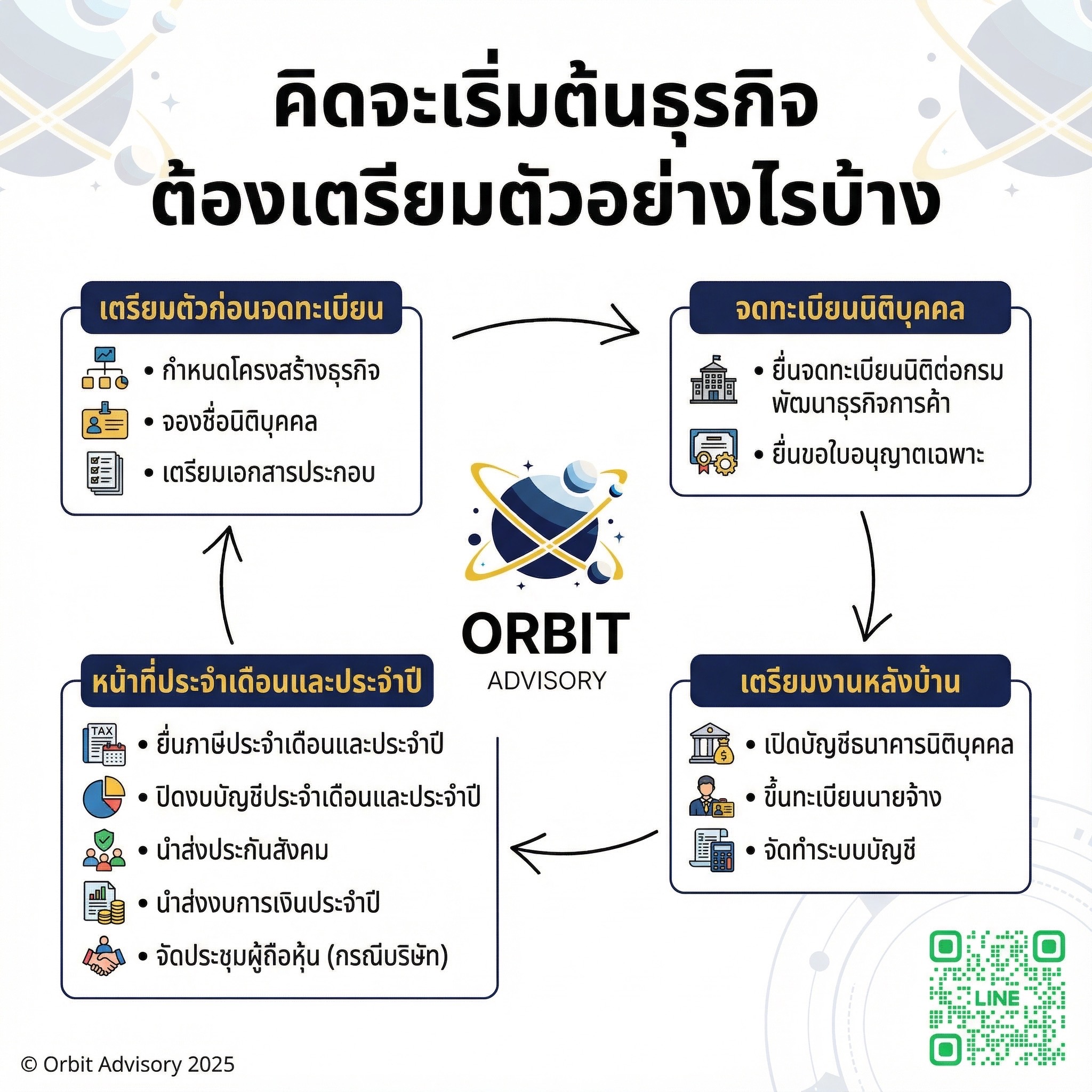
Complete Guide to Company Registration in Thailand: Steps, Documents, and Fees
Step-by-step guide to registering a company in Thailand: required documents, DBD process, fees, and first-year tax obligations.
Swipe to see more →
Ready to Take Action?
Our expert team is ready to help you achieve your financial goals. Contact us through your preferred channel.